
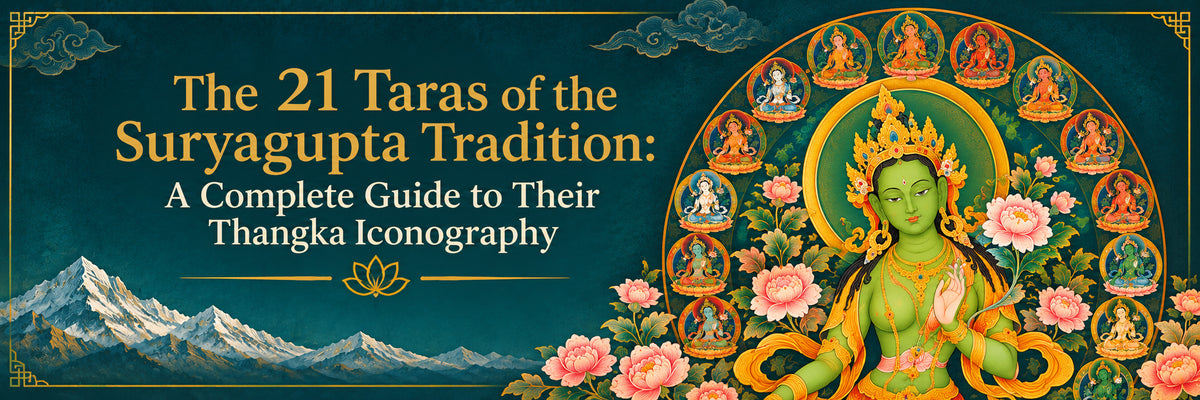
The 21 Taras of the Suryagupta Tradition: A Complete Guide to Their Thangka Iconography
Imagine standing before a collection of traditional Tibetan Thangka paintings. At first glance, the figures may appear to belong to one family of deities. Many sit upon lotus thrones, wear elaborate golden ornaments, and hold sacred objects in their hands. Yet as you look closer, you begin to notice extraordinary differences. One Tara is green and peaceful, another is red with eight arms, another has three faces, and another rides a bull.
These are the Twenty-One Taras of the Suryagupta tradition, a distinctive lineage of Tara practice within Tibetan Buddhism.
Each manifestation has a particular appearance, including her body colour, number of arms, hand gestures, ritual attributes, posture, and symbolic associations. These details are central to understanding the paintings. A lotus, vajra, vase, sword, hook, or even a particular animal beneath a deity can help identify the form.
The Suryagupta tradition is especially remarkable because its Taras are depicted in visibly different ways rather than repeating the same basic figure with only a change in colour. Specialist collections of Tibetan Buddhist art document these distinct forms and their prescribed iconography.
This guide explores the central Green Tara and the twenty-one individual manifestations represented in this collection, explaining their appearances, significant attributes, and traditional meanings.
Understanding the Twenty-One Taras
Tara is a female enlightened figure revered throughout Tibetan Buddhism. Her name is associated with liberation, and she is widely understood as an embodiment of compassionate activity that helps beings move beyond fear and difficult circumstances.
The Twenty-One Taras represent different aspects of this compassionate activity. Their forms are understood within devotional and tantric traditions, where each manifestation has a distinct iconographic identity.
Several traditions of the Twenty-One Taras exist, including those associated with Atisha, Longchenpa, and Suryagupta. In the Suryagupta tradition, the individual forms may have different colours, numbers of arms, facial expressions, hand gestures, and ritual implements.
One important detail about this collection is that Green Tara is displayed separately as the central or foundational figure, followed by twenty-one individual Tara forms. This means the collection contains twenty-two paintings when the central Green Tara is included.
Names and numbering can vary between traditional sources and particular iconographic collections. The descriptions below follow the names associated with your photographs, including Trailokyavijaya Tara, Apada Vimocani Tara, and Samkusumita Tara.
Who Was Suryagupta?
Suryagupta, known in Tibetan as Nyima Bé, is remembered as an Indian Buddhist master associated with Tara practice. Traditional accounts connect him with Kashmir and preserve a lineage of teachings concerning Tara's different manifestations.
The Suryagupta tradition provides detailed descriptions of each Tara's appearance, including her colour, posture, ornaments, facial features, hand gestures, and ritual objects.
These descriptions are particularly important for Thangka painters. Traditional Buddhist art is not simply an exercise in artistic imagination. The arrangement of the deity, the number of arms, the objects held, and the details of the throne all contribute to the figure's iconographic identity.
For a student or collector, learning these details opens the door to a deeper understanding of the paintings.
Green Tara: Khadiravani Tara, the Central Figure
Green Tara, known in this context as Khadiravani Tara or Tara of the Acacia Forest, is the central figure in the collection.
Her green body, peaceful expression, and relaxed royal posture create an immediate impression of compassion and readiness. She sits upon a lotus throne, with one leg folded and the other extended toward the ground.
Her right hand displays a gesture associated with generosity and granting, while her left hand holds the stem of a blue utpala lotus near her heart. The flower blossoms beside her shoulder.
The lotus is one of the most important symbols in Buddhist art. Growing from muddy water yet opening into a beautiful flower, it represents the possibility of awakening amid the difficulties of ordinary existence.
Green Tara is widely associated with swift compassionate activity and protection from fear. Her extended leg reinforces the visual impression of readiness to respond to the needs of beings.
Her central position provides the starting point for understanding the more varied manifestations surrounding her.
The Twenty-One Individual Tara Forms
1. Pravira Tara: Tara the Heroine

Pravira Tara is a red, eight armed manifestation associated with heroic activity and the overcoming of obstacles.
Her most recognizable feature is the pair of hands crossed above her head, holding a vajra and bell. Her other hands carry a bow and arrow, a wheel and conch, and a sword and noose.
Each object contributes to her identity. The vajra and bell have important meanings in Vajrayana Buddhism, where they are associated with complementary principles of method and wisdom. The bow, arrow, wheel, conch, sword, and noose further distinguish her from the other Taras.
Her red body is associated with powerful activity, while the arrangement of her eight arms communicates a broad range of enlightened functions.
Pravira Tara's image conveys courage and determination in the face of hindrances. Her heroic identity is expressed not only through her name but through the coordinated arrangement of her hands and ritual implements.
2. Candrakanti Tara: Tara White as the Autumn Moon

Candrakanti Tara is distinguished by her white central face, blue and yellow side faces, and twelve arms. Her elaborate appearance makes her one of the most visually complex figures in the collection.
Her faces and numerous hands are carefully arranged, with different ritual objects held in different positions. These include a ritual staff, water vessel, wheel, jewel, vajra, flower garland, lotus, bell, flask, and sacred text.
Her lowest hands rest in a contemplative gesture, creating a contrast with the multiple attributes surrounding her.
Candrakanti's white appearance evokes the clarity and luminosity associated with the moon. Her traditional devotional associations include protection and prayers for well-being and longevity.
The combination of three faces and twelve arms is particularly useful when identifying her. Looking beyond her colour to the number of faces and the arrangement of the objects is the key to recognizing this Tara.
3. Kanakavarna Tara: The Golden Coloured Tara

Kanakavarna Tara is a golden yellow manifestation with one face and ten arms.
She sits upon a multicoloured lotus above a sun disc. Her hands hold a rosary, sword, arrow, vajra, ritual staff, silk ribbon, noose, lotus, bell, and bow.
The variety of these attributes gives the painting its distinctive visual character. Each object forms part of the traditional iconography and helps distinguish her from the other golden or yellow Taras.
Yellow and golden colours are often associated with increase and auspicious activity in Vajrayana iconography, although the specific meaning depends on the individual deity and ritual context.
Kanakavarna's numerous arms communicate the breadth of her enlightened activity. The rosary suggests sustained practice, while the other implements form part of her individual symbolic identity.
Her painting demonstrates why understanding the attributes is essential when studying the Suryagupta tradition.
4. Ushnishavijaya Tara: Tara of the Victorious Crown

Ushnishavijaya Tara is a golden yellow Tara associated with the ushnisha, the crown protuberance of a Buddha, which symbolizes complete awakening.
She has four arms and sits in a relaxed posture upon a lotus and moon disc. Her right hands display a granting gesture and hold a rosary, while her left hands carry a vase and a ritual club.
The vase is associated with ritual blessing and purification. The rosary, meanwhile, is connected with recitation and devotional practice.
Her name and attributes establish her identity within the series. Unlike Kanakavarna Tara, who has ten arms, Ushnishavijaya has a simpler four armed form.
She is traditionally connected with prayers concerning longevity, protection, and well-being. These associations belong to Buddhist devotional practice and should not be understood as guarantees of particular outcomes.
Her image communicates dignity, blessing, and the symbolism of awakened qualities.
5. Humsvara-nadini Tara: Tara Who Proclaims the Sound of HUM

Humsvara-nadini Tara is a peaceful, yellow bodied Tara with two arms.
Her right hand displays a gesture associated with protection, while her left hand holds the stem of a lotus. The relatively simple arrangement makes her different from the many armed manifestations in the collection.
Her name refers to the sacred syllable HUM, which has an important role in Vajrayana Buddhist mantras and tantric practice.
Sound and mantra are significant elements of Tibetan Buddhist devotion. A sacred syllable can function as more than a spoken word; it may be used within a ritual or meditative system associated with a particular deity.
Humsvara-nadini's appearance communicates a quieter form of enlightened activity through her peaceful expression and restrained attributes.
Her traditional associations include protection from fear and the cultivation of confidence through devotional practice.
6. Trailokyavijaya Tara: Tara Victorious over the Three Worlds

Trailokyavijaya Tara is the red, four armed manifestation shown in your newly supplied photograph.
Her hands and ritual objects make her especially distinctive. Two of her hands hold a vajra and a sword, while the other pair displays a threatening gesture and holds a noose.
The threatening gesture is known in Buddhist iconography as a wrathful or subjugating gesture. It communicates forceful activity directed toward overcoming obstacles and obstructive forces. It should not be interpreted as ordinary human aggression.
Her name refers to victory over the three worlds, traditionally understood as the realms of desire, form, and formlessness. The red body and sun disc are consistent with the visual language associated with her form in the Suryagupta tradition.
The vajra, sword, and noose are central to recognizing this Tara. Her four armed composition distinguishes her from Pravira Tara, whose eight arms form a far more complex arrangement.
Including Trailokyavijaya Tara completes an important part of your photo collection and places her in the traditional sequence after Humsvara-nadini Tara.
7. Vadi Pramardini Tara: Tara Who Overcomes Adversaries

Vadi Pramardini Tara is a dark, wrathful manifestation with four arms.
Her iconography includes a wheel, a lotus bearing a vajra, a sword, and a threatening gesture. These ritual attributes distinguish her from the other wrathful Taras in the collection.
The term Vadi Pramardini is associated with overcoming adversaries. In the Buddhist symbolic context, this activity can refer to the removal of opposition and confusion that obstruct the path.
Wrathful appearance does not mean the absence of compassion. In tantric Buddhist imagery, a fierce expression can communicate decisive enlightened activity directed toward harmful influences and obstructive states of mind.
The contrast between her dark body and ritual implements gives the painting a very different character from the peaceful white and golden forms.
Her four arms and distinctive collection of attributes are particularly helpful for identifying her correctly.
8. Mara-Sudana Vasitottama Tara: Tara Who Overcomes the Maras

This Tara is golden yellow and has four arms. She is also associated in some iconographic references with the name Vashitottamada Tara.
Her painting includes an especially distinctive feature: a dragon-like or makara-like creature beneath her seat. This detail helps distinguish her from the other yellow Taras.
Her hands carry an ashoka branch, a lotus, a jewel, and a vase. Each object contributes to her individual iconography.
The ashoka branch is a recurring motif in Tara imagery. Its name is traditionally associated with freedom from sorrow, while the jewel and vase are linked with auspiciousness, blessing, and abundance.
Her name connects her with overcoming the maras, the forces traditionally understood to obstruct awakening.
The combination of her golden body, four arms, ritual attributes, and unusual animal support makes her one of the most visually recognizable paintings in this collection.
9. Varada Tara: Tara Who Grants Boons

Varada Tara is a red Tara with four arms.
Her upper pair of hands crosses above her head, holding a vajra and bell. Her other right hand makes a snapping or dancing gesture, while her remaining left hand holds an ashoka branch.
The position of the upper arms creates a distinctive silhouette. This is one of the most useful clues for distinguishing Varada Tara from Soka Vinodana Tara, whose upper hands also meet above her head but whose other attributes differ.
The name Varada is associated with giving or granting. This meaning is reflected in her iconography and traditional associations with blessing, generosity, and auspicious beginnings.
The vajra and bell add a further layer of tantric symbolism.
Her painting shows how posture and the arrangement of the hands are as important as body colour when interpreting a Thangka.
10. Soka Vinodana Tara: Tara Who Dispels Sorrow

Soka Vinodana Tara is a coral red or red Tara with four arms.
Her upper pair of hands meets above her head in a gesture of prayer. Her other hands hold a sword and a flowering ashoka branch.
Her name is associated with dispelling sorrow. The ashoka tree is particularly meaningful in this context because its name is traditionally interpreted as the sorrowless tree.
The sword and flowering branch create an interesting contrast. One represents the cutting through of obstacles, while the other introduces imagery of beauty and renewal.
Soka Vinodana Tara's peaceful facial expression also distinguishes her from more strongly wrathful manifestations in the series.
Her image presents a devotional association with the easing of sorrow and the cultivation of a clearer, more compassionate perspective.
11. Apada Vimocani Tara: Tara Who Frees from Danger

Apada Vimocani Tara is a dark, wrathful Tara with two arms.
She is seated on a lotus above a sun disc and holds a hook and a lasso. These two implements are among the clearest features for identifying her.
In Buddhist iconography, the hook and lasso can be associated with drawing in, restraining, or overcoming obstructive forces. Their presence gives her image a protective character.
Her dark body and wrathful expression make her visually distinct from the peaceful forms elsewhere in the collection.
The name Apada Vimocani is associated with release from danger or difficult circumstances. Her traditional devotional role is therefore connected with protection and the overcoming of obstacles.
In studying this painting, begin with the two arms and the hook and lasso rather than relying on body colour alone.
12. Mangalaloka Tara: Tara of Auspicious Light

Mangalaloka Tara is a golden yellow Tara with eight arms.
She sits upon a multicoloured lotus, and her hands hold a trident and jewel, a pair of hooks, a vajra and ritual staff, and a sword and vase.
The arrangement of these objects creates a complex yet carefully ordered composition. Each pair helps distinguish her from the other multi armed Taras.
Her name is associated with auspicious light. The golden colour of her body reinforces this association, while the jewel and vase suggest blessing and favorable circumstances in the traditional symbolic language.
Mangalaloka Tara is linked with auspiciousness and the cultivation of positive conditions for spiritual practice.
Her painting is an excellent example of how multiple ritual objects can form a coherent iconographic identity. The objects should be read as a group rather than as separate decorations.
13. Paripachaka Tara: Tara the Ripener

Paripachaka Tara is a red, wrathful manifestation with four arms.
She is depicted with a sword and wheel in one pair of hands and a bow and arrow in the other. These objects make her comparatively easy to distinguish from other red Taras.
Her name is associated with ripening or bringing something to maturity. Within Buddhist thought, the path develops through practice and understanding rather than appearing fully formed from the beginning.
The sword and wheel provide a visual contrast with the bow and arrow, while her red body and wrathful expression reinforce her distinctive form.
Paripachaka Tara's traditional associations concern the subduing of hindrances and the maturation of positive activity.
Her image illustrates an important feature of the Suryagupta tradition: the specific combination of attributes identifies the Tara more precisely than colour alone.
14. Bhrikuti Tara: The Frowning Tara

Bhrikuti Tara is one of the most striking wrathful forms in the collection.
She has three faces and six arms. Her face arrangement includes dark, pale, and red tones, and her wrathful expression is emphasized through her ornaments and ritual implements.
Her hands carry a sword and skull cup, a hook and noose, and a ritual club and head. These objects belong to a specific tantric iconographic vocabulary and must be understood within that religious context.
The combination of three faces, six arms, and a fierce expression gives Bhrikuti Tara a very different appearance from the peaceful two armed figures.
Her traditional symbolism is associated with the overcoming of harmful thoughts and obstacles.
Bhrikuti's image demonstrates how wrathful forms can communicate uncompromising activity directed against ignorance and hindrances rather than ordinary anger toward other beings.
15. Mahashanti Tara: Great Peaceful Tara

Mahashanti Tara is a white, peaceful Tara with six arms.
She sits on a moon disc in a meditative posture. Her hands hold a rosary, display a granting gesture, and carry a vajra topped club. The other hands hold a lotus in meditation, a vase associated with blessed water, and a lotus bearing a sacred text.
These objects bring together several important themes: recitation, generosity, ritual cleansing, and wisdom.
Her white body and composed expression contrast with the wrathful forms that appear elsewhere in the collection.
The name Mahashanti means Great Peace. Her iconography reflects that association through her peaceful face and balanced posture, while the attributes communicate a more complex set of devotional meanings.
The painting shows that a peaceful deity can still have a rich and detailed iconography.
16. Raga Nisudana Tara: Tara Who Overcomes Attachment

Raga Nisudana Tara is a red or coral red Tara with two arms.
She holds a trident near her heart, while her other hand raises a branch bearing leaves, flowers, or fruit. The combination of these two elements is a useful feature for identifying her.
Her name is associated with overcoming attachment. In Buddhist philosophy, attachment is understood as a force that can cloud discernment and reinforce dissatisfaction.
The flowering branch introduces a natural image of growth, while the trident provides a strong ritual symbol. The contrast makes her painting visually distinctive.
Compared with the multi armed Taras, her form is relatively simple, allowing the viewer to focus on the two principal attributes.
Raga Nisudana's traditional symbolism encourages reflection on clarity, discernment, and the possibility of overcoming attachment through practice.
17. Sukha Sadhana Tara: Tara Who Accomplishes Bliss

Sukha Sadhana Tara is a golden orange Tara with two arms.
She sits on a sun disc and lotus and holds a moon disc at the level of her heart with both hands. This is her most distinctive iconographic feature.
The moon disc is the focal point of the painting and separates her from other two armed Taras who hold a vase, flower, branch, or ritual implement.
Her name refers to the accomplishment of bliss. In a Vajrayana context, this terminology belongs to a particular spiritual and meditative framework rather than simply meaning a passing feeling of happiness.
The combination of her body colour, lotus seat, and moon disc creates a balanced composition.
Sukha Sadhana Tara demonstrates that a figure does not need multiple arms or elaborate implements to possess a distinctive identity. Sometimes one central object is enough.
18. Samkusumita Tara: The Fully Blossomed Tara

Samkusumita Tara is a white, peaceful Tara with four arms.
Her upper pair of hands holds hooks crossed above her head. One of the lower hands displays a granting gesture, while the other holds a lotus supporting a sacred text.
The crossed hooks are particularly important for identifying this Tara. Her white body and peaceful expression alone would not be enough to distinguish her from every other white manifestation.
The lotus bearing a text connects her image with purity and wisdom. The granting gesture communicates generosity, while the hooks belong to the ritual symbolism of this particular form.
Her name is associated with blossoming or full flowering, suggesting the completion or flourishing of positive qualities.
The arrangement of her hands and attributes makes Samkusumita Tara a valuable example of why careful iconographic study is essential in traditional Thangka art.
19. Dukha Dahana Tara: Tara Who Consumes Suffering

Dukha Dahana Tara is a white, two armed Tara seated on a moon disc and lotus.
She holds a triangular fire brazier at the level of her heart. The brazier is the defining attribute of her image.
The fire provides a visual symbol for consuming or transforming suffering within the traditional devotional interpretation.
Her white body and peaceful expression contrast with the flames held at her heart. This gives the painting a compelling combination of calmness and transformation.
Unlike the Taras who carry numerous ritual objects, Dukha Dahana's iconography concentrates attention on one principal implement.
Her name is associated with the consumption of suffering, and her traditional devotional context includes prayers concerning troubling dreams and difficult circumstances.
The brazier is the first detail to look for when distinguishing her from other white Taras.
20. Siddhisambhava Tara: Tara, Source of Attainments

Siddhisambhava Tara is an orange Tara with two arms.
She sits upon a red lotus above a moon disc and holds a golden vase at the level of her heart.
The vase is her defining attribute. In Buddhist art, a vessel may be associated with blessing, abundance, or the holding of sacred substances. Its meaning depends on the specific deity and ritual tradition.
Her name refers to the arising or source of attainments. In Vajrayana Buddhism, the term siddhi refers to accomplishments or attainments associated with spiritual practice.
The simplicity of Siddhisambhava Tara's form makes her easy to distinguish from the multi armed manifestations. The vase, body colour, and lotus seat work together to establish her identity.
Her image presents the idea of fruition and accomplishment within the symbolic world of Tara practice.
21. Paripurana Tara: Tara the Perfecter

Paripurana Tara completes the sequence of individual manifestations in this collection.
She is white and semi wrathful, with three eyes, and is shown riding a bull. Her right hand holds a trident, while her left holds a pearl rosary. She wears a tiger skin garment.
The bull is one of the most distinctive features of her iconography. It immediately separates her from the other Taras in this series.
Her three eyes are associated with expanded awareness, while the trident and rosary form the principal ritual attributes. The tiger skin contributes to her fierce visual identity.
Her name is associated with completion or fulfilment. The combination of the bull, trident, rosary, and semi wrathful expression gives her a unique position within the collection.
Paripurana Tara brings the sequence to a close by showing once again how a specific arrangement of attributes distinguishes each Tara from the others.
How to Understand Tara Symbolism in Thangka Art
Once you begin recognizing the individual Tara forms, the next step is learning to read their paintings as a whole.
Body Colour
Colours can help identify the different manifestations. Green, white, yellow, red, and dark bodies occur throughout the collection. They may be connected with different types of enlightened activity, but their precise meaning depends on the specific deity and tradition.
Number of Arms and Faces
The number of arms and faces often provides one of the clearest clues to a Tara's identity. Candrakanti's three faces and twelve arms, for example, distinguish her from Humsvara-nadini's simpler two armed form.
Hand Gestures
Mudras communicate particular meanings. A granting gesture, a protective gesture, a threatening gesture, and a meditation gesture are not interchangeable. Their positions are important parts of the iconography.
Ritual Objects
The vajra, bell, lotus, sword, rosary, hook, vase, bow, arrow, and other objects identify individual Taras and contribute to their traditional symbolism.
Lotus Seats, Discs, and Animal Mounts
Moon discs, sun discs, lotus thrones, and animal mounts are additional visual clues. The dragon-like creature associated with Mara-Sudana Vasitottama Tara and the bull associated with Paripurana Tara are examples of features that make specific figures recognizable.
Peaceful and Wrathful Expressions
Peaceful forms usually have calm faces, while wrathful forms may display fierce expressions and more dynamic attributes. In Vajrayana Buddhist iconography, both can express enlightened activity. The difference lies in how that activity is represented.
Why the Suryagupta Tradition Matters for Thangka Collectors
The Suryagupta tradition demonstrates how intricate Buddhist iconography can be. A single enlightened figure is represented through a family of manifestations, each with its own visual identity.
For artists, these distinctions create a detailed framework for painting each Tara accurately. For collectors and students, they provide a method of reading and identifying the images.
The number of arms, the position of a ritual implement, the colour of the body, the seat, and even the animal beneath the deity can help establish a figure's identity.
A painting becomes more than a beautiful decorative object. It becomes a record of iconographic knowledge preserved through religious traditions and artistic lineages.
Approaching the Twenty-One Taras With Respect
The Twenty-One Taras belong to a living Buddhist devotional tradition. Their paintings are valued not only for artistic complexity but also for their place in prayer, ritual, and meditation.
Studying the history and visual symbolism of these images is a valuable way to appreciate them. Formal deity yoga practices and specific sadhanas, however, are traditionally approached through qualified teachers and the appropriate lineage instructions.
Learning the names, attributes, and iconographic details provides a strong foundation for understanding the paintings and the traditions they represent.
Conclusion: A Visual Language of Compassion
The Suryagupta tradition presents Tara through a remarkable range of forms. Green Tara provides the central focus, while the twenty-one individual manifestations surrounding her express different aspects of Tara's identity through colour, posture, hand gestures, and ritual objects.
From Pravira Tara's eight arms to Trailokyavijaya Tara's vajra and sword, from Samkusumita Tara's scripture-bearing lotus to Paripurana Tara's bull mount, every figure offers clues to its identity.
The more closely you study the paintings, the more clearly this visual language begins to emerge.
Understanding the Twenty-One Taras is therefore not simply a matter of memorizing names. It is a way of discovering the history, symbolism, and artistic precision contained within Tibetan Buddhist Thangka painting.


